Shop by

Houseplants and essential oils might make your home look and smell amazing, but they won't protect it. We've manufactured millions of air filters right here in the U.S., and we've seen firsthand what collects on them: dust, pollen, pet dander, mold spores, and particles so fine you'd never know they were there. No potted fern or lavender diffuser is trapping any of that.
The reality is, your HVAC filter is the only thing standing between your family's lungs and everything floating through your ductwork. Plants and oils can complement clean air, but they can't create it. Here's what actually works, why it works, and how to get the most from all of it.
No. Plants and essential oils cannot replace HVAC filters.
After manufacturing millions of air filters in the U.S. and seeing what they capture in real homes, here's what we know for certain:
Houseplants can absorb trace amounts of certain gases, but only in sealed lab conditions. In a real home, you'd need hundreds to thousands of plants to match what basic ventilation already provides.
Essential oil diffusers don't remove pollutants. Research shows they actually add VOCs to your indoor air.
Your HVAC filter is the only thing physically trapping dust, pollen, pet dander, mold spores, and microscopic particles as your system circulates air throughout your home, multiple times per day.
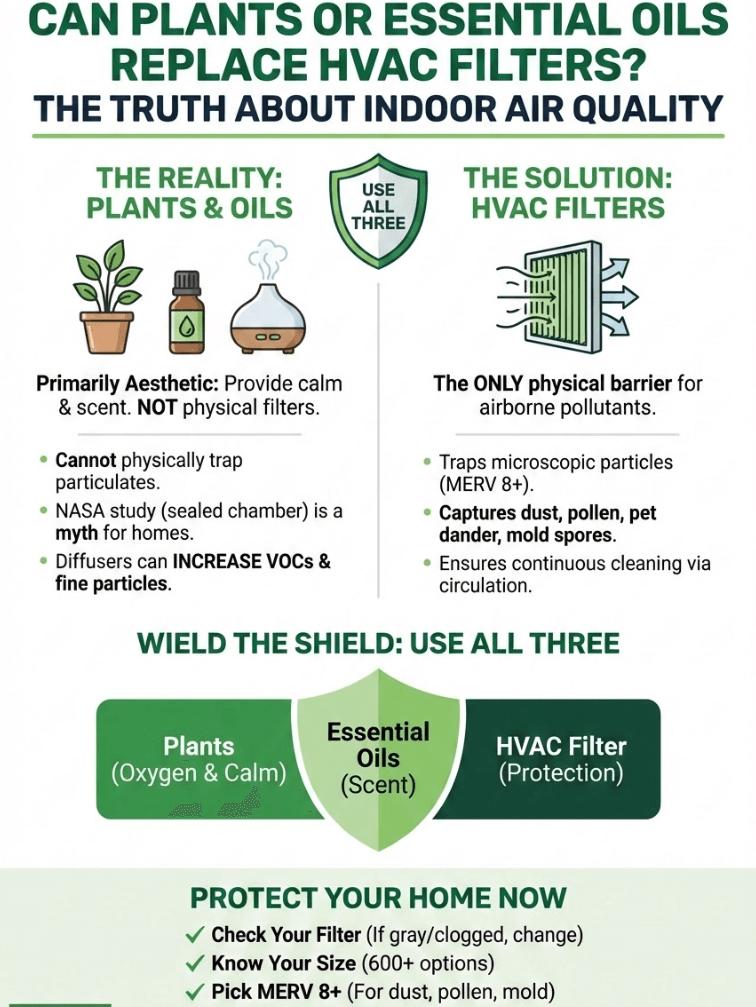
The bottom line: Plants add oxygen and calm. Diffusers add scent. Your air filter adds protection. Use all three, but only one is doing the real work of keeping your air clean.
Plants can't replace your HVAC filter. The NASA study was done in a sealed chamber, not a real home. You'd need hundreds to thousands of plants to match what basic ventilation already handles.
Essential oil diffusers add pollutants; they don't remove them. Research shows diffusing oils increases VOCs and carbon monoxide indoors. Your filter works harder, not less.
Indoor air is 2–5x more polluted than outdoor air. You're breathing it 90% of the day. Only mechanical filtration can keep up with that volume.
A MERV 8+ filter is the single most effective step for cleaner air. It captures dust, pollen, pet dander, mold spores, and microscopic particles every time your system runs.
Use all three where they work best. Plants for oxygen and calm. Diffusers for scent. Your air filter for protection.
You've probably seen the famous 1989 NASA Clean Air Study that found certain houseplants can absorb volatile organic compounds (VOCs) like formaldehyde and benzene. That study is real, but context matters. Those results came from small, sealed chambers, nothing like the open, ventilated rooms in your home. In a typical living space, you'd need hundreds of plants to make a measurable dent in air quality, and even then, they wouldn't touch particulate pollutants like dust, dander, or mold spores. Plants are great for your home. They're just not air filtration systems.
Essential oils can make a room smell wonderful, and some, like tea tree and eucalyptus, have mild antimicrobial properties in laboratory settings. But diffusing them into your living room isn't the same as filtering your air. In fact, some diffusers actually release VOCs into your home's atmosphere, which can irritate sensitive airways, especially for people with asthma or allergies. So while that peppermint diffuser might feel refreshing, it's adding to what your HVAC filter needs to catch, not reducing it.
Your HVAC system moves all the air in your home through its filter multiple times a day. That filter is physically capturing the particles that affect your health and comfort: pollen, dust mites, pet dander, mold spores, bacteria, and more. From our experience building filters for over a decade, we can tell you that what a used filter collects after just 90 days would convince anyone that plants and oils alone aren't enough. A quality pleated filter rated MERV 8 or higher is engineered to trap the microscopic particles that natural alternatives simply can't.
Absolutely, and we'd encourage it. Houseplants add oxygen and a sense of calm to your space. Essential oils can help your home smell great. But think of them as complements to your air filter, not replacements. The best approach to indoor air quality is a layered one: start with a reliable HVAC filter doing the heavy lifting, then add the natural extras that make your home feel like yours.
Plants and essential oils have real benefits, just not when it comes to filtering the air your family breathes every day. That job belongs to your HVAC filter, and keeping it fresh is one of the simplest, most impactful things you can do for your home. Whether you're managing allergies, pet hair, or just want peace of mind, the right filter makes all the difference.
"After more than a decade of manufacturing air filters and seeing what they pull out of the air in real homes, we can tell you, no plant or essential oil comes close to doing what a quality HVAC filter does every single day. They're nice additions to a healthy home, but your filter is the one doing the protecting."
-Filterbuy Team
We get it, the idea of using something natural to clean your air sounds appealing. But when it comes to protecting your family's health and your home's comfort, you deserve the full story. We've pulled together the most trustworthy sources out there so you can see the facts for yourself, no jargon, no guesswork.
Back in 1989, NASA found that houseplants could absorb certain chemicals inside a tiny sealed chamber. That's a long way from your living room. This is the study everyone references, and it's worth a quick look to understand what it really said (and what it didn't).
Source: NASA Technical Reports Server
Check it out: https://ntrs.nasa.gov/citations/19930073077
Drexel University researchers looked at three decades of plant studies and did the math. Their finding? You'd need somewhere between 10 and 1,000 plants per square meter of floor space to match what basic ventilation already handles. That's not a few potted ferns, that's a jungle. This study is the clearest proof that plants just aren't built for this job.
Source: Journal of Exposure Science & Environmental Epidemiology
Check it out: https://www.nature.com/articles/s41370-019-0175-9
If you want the science without the science-speak, start here. The American Lung Association breaks down exactly why those lab studies don't translate to real homes, and flags something a lot of people miss: overwatered houseplants can actually grow mold that makes allergies and asthma worse. Good to know before you stock up on spider plants.
Source: American Lung Association
Check it out: https://www.lung.org/blog/houseplants-dont-clean-air
Here's one that surprises a lot of homeowners. Researchers tested what happens when you diffuse lavender, eucalyptus, and tea tree oils indoors, and found that VOC and carbon monoxide levels went up, not down. That means your diffuser may actually be adding to the pollutant load your HVAC filter has to deal with. It's not harmful in small doses, but it's definitely not filtering anything.
Source: Atmospheric Environment (Peer-Reviewed)
Check it out: https://www.sciencedirect.com/science/article/abs/pii/S1352231006009939
We talk about MERV ratings a lot because they matter. MERV stands for Minimum Efficiency Reporting Value, and it's the standard way to measure how well an air filter captures the particles floating through your home, things like pollen, pet dander, dust mites, and mold spores. The EPA's guide makes it easy to understand what each rating level does and why a MERV 8 or higher is a smart starting point for most homes.
Source: U.S. Environmental Protection Agency
Check it out: https://www.epa.gov/indoor-air-quality-iaq/what-merv-rating
Most people don't realize how many pollutant sources are already in their homes, from cooking fumes and cleaning products to building materials and pet dander. This EPA guide covers all of it, including why the agency recommends mechanical filtration through your HVAC system as one of the most effective steps you can take. It's a helpful read if you want the big picture on indoor air quality.
Source: U.S. Environmental Protection Agency
Check it out: https://www.epa.gov/indoor-air-quality-iaq/inside-story-guide-indoor-air-quality
If you like seeing hard data, this University of Toronto study is the one to bookmark. Researchers measured exactly how much VOC and particulate matter ultrasonic diffusers put into the air when using lemon, lavender, eucalyptus, and grapeseed oils. The results make it pretty clear: diffusers create pleasant scents, but they're adding particles to your air, not removing them.
Source: Indoor Air (Peer-Reviewed) / PubMed
Check it out: https://pubmed.ncbi.nlm.nih.gov/33905580/
We've manufactured millions of air filters in the U.S. for over a decade. Here's what the data confirms about what we witness every day.
We hear from customers all the time who assumed their indoor air was cleaner, until they saw what their first Filterbuy filter trapped in just 90 days.
The EPA's research backs up what those dirty filters show:
Common organic pollutants inside homes consistently measure at 2 to 5 times outdoor concentrations, regardless of whether the home is in a rural or industrial area
VOCs from cleaning products, cooking, building materials, and even scented diffusers all contribute to that pollutant load
In some cases, indoor concentrations can spike to 100 times outdoor levels during activities like painting or heavy cleaning
No number of houseplants can keep up with that volume. Your HVAC filter can.
Source: U.S. Environmental Protection Agency — Indoor Air Quality Report
This is the stat that shaped how we build our filters. Nine out of ten hours, your family is breathing the same recirculated air, which means the filter in your HVAC system isn't just a maintenance item. It's the front line.
That's why we:
Engineer our filters to commercial-grade quality standards
Offer 600+ sizes, including custom options, so every home gets a filter that fits right
Ship factory-direct with free delivery, making it easy to stay on schedule
A lavender diffuser might make your air smell great. But it's not removing the dust, dander, and mold spores cycling through your ductwork all day.
Source: U.S. Environmental Protection Agency — Indoor Air Quality Report
We hear from these families every week. The most common indoor asthma and allergy triggers include:
Dust mites
Pet dander
Mold spores
Pollen
Airborne particles from cooking and household products
The Asthma and Allergy Foundation of America reports that asthma now affects about 1 in 12 Americans. For these households, a potted fern or a few drops of eucalyptus oil can't reduce those triggers the way a pleated MERV 8 or higher filter can.
We built our business around making that level of protection simple: quality filters, made in the USA, delivered to your door, because for millions of families, cleaner air isn't optional.
Source: Asthma and Allergy Foundation of America — Asthma Health Outcomes
We love seeing houseplants in our customers' homes. A good essential oil diffuser? We're fans of that, too. But after building air filters for over a decade and seeing what collects on them in just 90 days, we can say with confidence that plants and oils aren't in the same category as mechanical filtration.
The NASA study behind the "plants clean your air" claim was conducted in a sealed chamber, not a real home with HVAC airflow, open doors, and pets
Essential oil diffusers don't remove pollutants, research shows they actually add VOCs to your air
Your HVAC filter captures dust, pollen, pet dander, mold spores, and microscopic particles multiple times a day, none of which a snake plant or tea tree oil can touch
Indoor air can be 2-5x more polluted than outdoor air, and you're spending 90% of your time breathing it
The trend toward natural living is a good one. But when it gets applied to air quality, it can lead people to skip the one thing that's actually protecting them.
We've talked to homeowners who went months without changing their filter because they believed their houseplants were "handling it." Once they saw what a fresh filter catches in its first few weeks, the conversation changed fast.
Plants → Add oxygen, calm, and life to your space
Essential oils → Make your home smell the way you want
Your air filter → Trap the invisible particles that affect your family's health, your HVAC efficiency, and your home's comfort
That's not a sales pitch. That's what we've learned from years of manufacturing filters, talking to real homeowners, and seeing the results with our own eyes.
Your air filter is the quiet workhorse of your home, and it deserves more credit than a potted fern.
You know what plants and oils can't do. Here's what you can do right now.
Pull it out and take a look. If it's gray, clogged, or you can't remember when you last changed it, it's time. A dirty filter wastes energy, strains your system, and lets particles through.
Find the dimensions printed on the side of your current filter. Filterbuy carries 600+ standard sizes plus custom options, so the right fit is just a few clicks away.
MERV 8 → Everyday protection, captures dust, pollen, and mold spores
MERV 11 → Pet owners and allergy sufferers, adds dander and fine dust capture
MERV 13 → Asthma, severe allergies, or high-pollution areas, traps bacteria, smoke, and virus carriers
Filters are easy to forget. Auto-delivery makes sure you don't.
Choose a schedule: every 30, 60, or 90 days
The right filter shows up at your door
No reminders. No store runs. Just clean air, on time.
They still have a role:
Plants → Oxygen, calm, and beauty
Essential oils → A home that smells the way you want
Your filter → The heavy lifting on air quality
Made in the USA = commercial-grade quality
600+ sizes = standard and custom
Free shipping = factory-direct, no middlemen
Auto-delivery = stay on schedule effortlessly
Millions shipped = trusted by families nationwide
→ Find your size at Filterbuy.com
A: Not in any meaningful way. Here's why:
The NASA study was conducted in a sealed chamber roughly the size of a trash can — not a real home
A 2019 Drexel University review confirmed you'd need 10–1,000 plants per square meter to match basic ventilation
We've pulled used filters from test homes loaded with dust, dander, and mold spores after just 90 days — no houseplant could catch what those filters did
Plants are great for oxygen, mood, and decor. They're just not filtration systems.
A: They're not dangerous in typical use — but they're not cleaning your air either.
Peer-reviewed research shows diffusing oils adds VOCs and carbon monoxide to your indoor air
That means your diffuser creates more work for your HVAC filter, not less
Many of our customers are surprised to learn their diffuser was adding particles, not removing them
Enjoy your diffuser for scent. Give your filter credit for the air quality work.
A: Your filter physically traps airborne particles every time your system runs, including:
Dust and dust mites
Pollen
Pet dander
Mold spores
Bacteria
Microscopic particles as small as 0.3 microns (depending on MERV rating)
We've examined thousands of used filters over the years. What they collect — gray, matted layers of particulates — is proof that nothing natural comes close. Plants can slowly absorb certain gases under ideal conditions but can't capture particulate matter. Essential oils release compounds into the air — they don't remove a single particle.
A: After shipping millions of filters to real homes, here's what we recommend:
MERV 8 → Everyday protection — captures dust, pollen, mold spores. Works with virtually any HVAC system.
MERV 11 → Pet owners and allergy sufferers — adds meaningful dander and fine dust capture. Our most common recommendation for families with pets.
MERV 13 → Asthma, severe allergies, wildfire-prone areas — traps smoke, bacteria, and virus carriers. Verify your system can handle it first.
Not sure? Start at MERV 8 and work up. That's the advice we give our own families.
A: Yes — and we recommend it. The best approach is a layered one:
Plants → Oxygen, greenery, and calm that a filter can't provide
Essential oils → A home that smells exactly the way you want
Your HVAC filter → The behind-the-scenes protection that traps invisible particles, keeps your system efficient, and safeguards your family's health
Think of plants and oils as the finishing touches. Your filter is the foundation. After seeing what our filters catch day after day across millions of homes, we wouldn't trust that job to anything else.
Stop guessing and start filtering with a quality HVAC filter built for your home. Find your size at Filterbuy.com. Made in the USA, shipped free, and delivered on your schedule.